
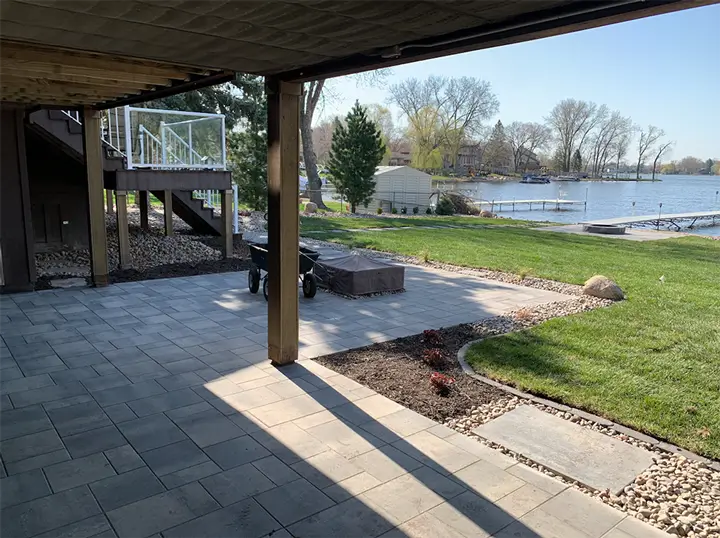
A paver patio is only as good as what is under it. The pavers are the part you picked out and the part you look at. The base is the part that decides whether you are still happy with it in ten years.
Nearly every sunken, wavy, separating patio we get called to look at failed from underneath.
What a Paver Base Actually Is
Under a properly built patio there are three layers, and each one has a job.
Compacted aggregate base. Crushed rock, installed in lifts and compacted as you go. This carries the load and spreads it out. It is the structural part.
Bedding layer. A thin, consistent layer of coarse sand or chip on top of the base. This is what the pavers set into. It is for leveling, not for support.
The pavers. Plus joint sand and edge restraint holding the whole field together.
The mistake that causes most failures is treating sand as the base. Sand does not compact into a load bearing layer. It moves.
How Deep Should the Base Be?
Depends on what the patio has to carry and what it is sitting on.
A walkway or light foot traffic patio can work on a shallower base.
A standard residential patio needs more, and in cold climates it needs more than the same patio would need down south.
Anything a vehicle touches, including a patio that connects to a driveway, needs a substantially deeper base than a patio people only walk on.
Soil matters as much as use. On the heavy clay found through most of Forest Lake and the northeast metro, you need more base than you would on sand, because clay holds water and offers less support when it is wet.
Depth is not a number you pull off the internet. It comes from the soil and the load together, and it is the first thing worth asking any contractor about.
Why Pavers Sink, Heave and Separate
Four causes, roughly in order of how often we see them.
Not enough base, or none at all. Pavers set on sand over soil. Looks fine the first season, then starts moving.
Base not compacted properly. Rock dumped in one deep layer instead of compacted in lifts. Looks solid, settles unevenly under load.
No edge restraint. Without something holding the perimeter, the field spreads outward. You see it as widening joints and loose pavers around the edges.
Water underneath. A patio that traps water, or sits where water collects, is a patio that will heave. Which brings us to the part that matters most here.
Minnesota Frost Changes the Math
This is where patios built to a southern spec fall apart in Minnesota.
Our ground freezes deep, and water expands when it freezes. Water sitting in or under a patio base lifts that section of patio as it freezes, then drops it as it thaws, not always back to where it started. Do that through a few dozen freeze-thaw cycles a year and a patio that was dead flat in October is visibly uneven by spring.
Two things prevent it, and both happen before a single paver is laid.
Drainage. The base has to shed water, and the patio has to be pitched so surface water runs away from the house rather than sitting on it.
Clean, properly compacted aggregate. Angular crushed rock locks together and drains. Compacted in lifts, it resists the movement that frost causes. Fines and soil mixed into the base hold water, and water is the problem.
Heavy clay makes both harder, which is why base prep on this side of the metro is not the place to save money.
Signs Your Patio Base Failed
- Low spots that hold water after rain
- Pavers rocking underfoot when you step on them
- Widening joints or sand washing out between pavers
- Edges spreading outward, with pavers coming loose at the perimeter
- A seasonal pattern, where it looks worse every spring than it did in fall
That last one is the tell for frost. If the patio shifts over winter and partly settles back in summer, water is getting into the base.
Can a Sunken Patio Be Fixed?
Often, yes, and usually for far less than a full replacement.
If the base is sound and only a section has settled, pavers can be lifted, the bedding corrected, and the same pavers reset. You lose nothing but labor.
If the base itself failed, that section has to come out and be rebuilt properly. Still cheaper than redoing the whole patio, as long as the rest was built right.
If the patio was set on sand with no real base, there is no fix that lasts. It gets rebuilt.
Knowing which one you have takes pulling a few pavers and looking.
Thinking About a Patio?
We build paver patios across Forest Lake, Hugo, Wyoming, Lino Lakes, White Bear Lake, Stillwater and the surrounding northeast metro, and we do the base the way it has to be done for this climate. We also get called out to fix plenty that were not.
Request a free quote or call (651) 775-4446.
See our paver patio work, or read about drainage if water is the bigger issue on your property.
Get Your Drainage Problem Solved
Standing water only gets worse the longer you ignore it. What starts as a soggy lawn can become foundation damage, and the fix only gets more expensive over time.
If you are dealing with standing water, a wet basement, or a yard you cannot use, John’s ProCare can help. We install and service French drains and complete drainage solutions across Forest Lake and central Minnesota.
