
If water pools in your yard after every rainstorm, sits against your foundation, or turns one corner of your lawn into a swamp that never fully dries out, you have a drainage problem and need a contractor. And if you have started looking into solutions, you have probably run into the term “French drain” more than once.
Here is what a French drain actually is, how it works, when you need one, and how to make sure it is installed correctly so it lasts.
What Is a French Drain?
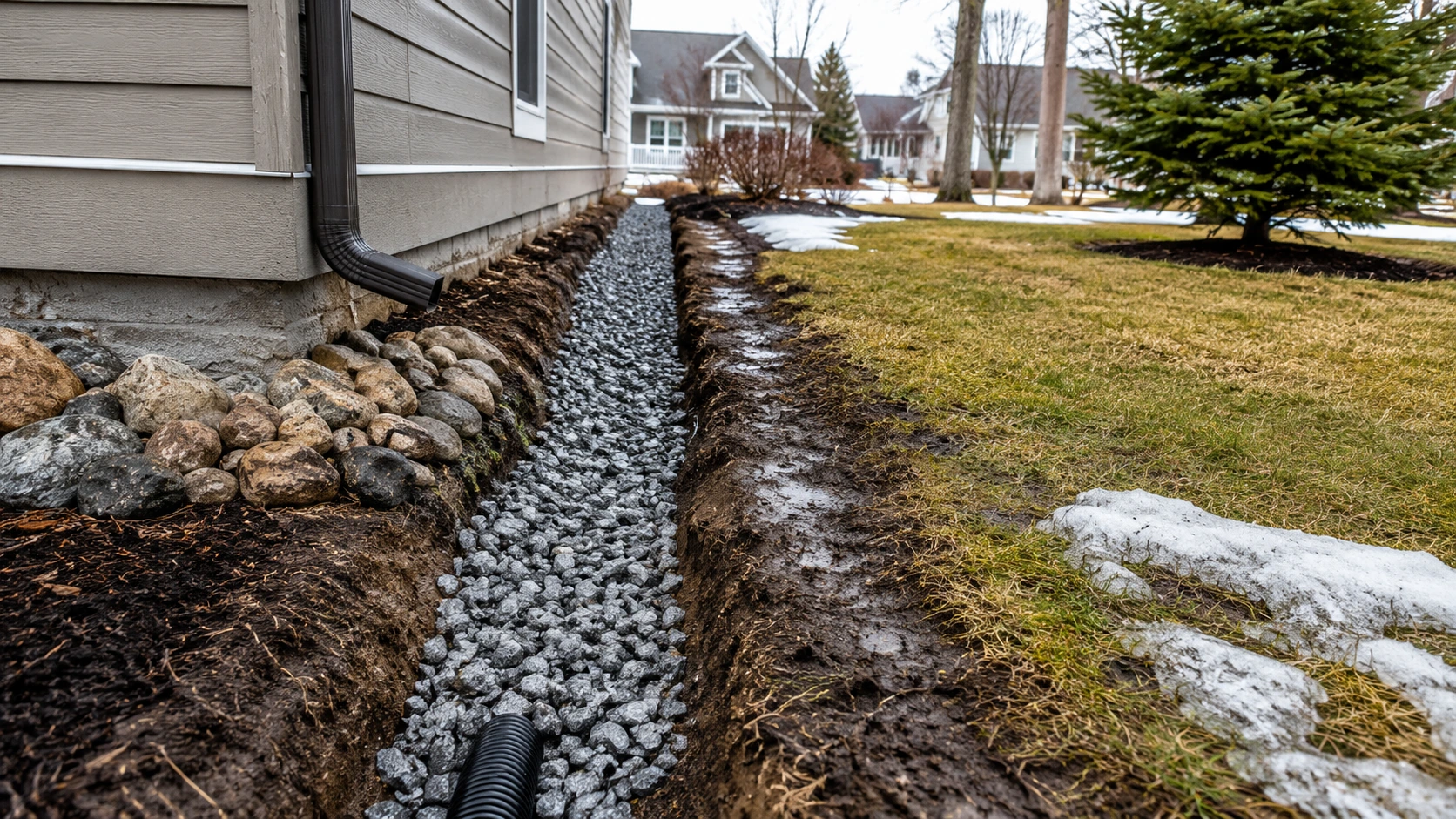
A French drain is a simple but highly effective drainage system: a gravel-filled trench with a perforated pipe running along the bottom. Water moving through the soil collects in the trench, drains into the pipe through the holes, and gets carried away to a spot where it can safely exit, away from your yard, your foundation, or wherever the water was causing trouble.
The name has nothing to do with France. It comes from Henry French, a 19th-century farmer and judge from Massachusetts who popularized the design in a book on drainage. The concept has barely changed since, because it works.
The basic idea is that water always follows the path of least resistance. A French drain gives standing water an easy path to follow, one that leads away from where you do not want it and toward where it can drain harmlessly.
How a French Drain Works
A properly built French drain has a few key components working together:
The trench. Dug on a slight slope so water flows in the direction you want it to go. The slope is critical. Even a small grade over the length of the trench keeps water moving instead of sitting.
Landscape fabric. Lines the trench to keep soil and sediment from clogging the gravel and pipe over time. Skip this step and the drain slowly fills with silt and stops working.
Gravel. Fills most of the trench. It creates the open space water needs to collect and flow, and it filters out debris before water reaches the pipe.
Perforated pipe. Sits near the bottom of the trench with holes that let water in. The pipe carries the collected water to the outlet point.
The outlet. Where the water exits, whether that is a lower area of the property, a storm drain, a dry well, or a daylight point where the pipe opens to the surface well away from the house.
When it rains, water saturates the soil and naturally moves down and toward the trench. It filters through the gravel, enters the pipe, and flows out the outlet. Instead of pooling on your lawn or seeping toward your basement, it is gone.
Signs You Might Need a French Drain
Not every wet spot calls for a French drain, but these are the classic signs it is the right solution:
- Standing water that lingers on your lawn for days after it rains
- Soggy, spongy areas of grass that never seem to dry out
- Water pooling near or against your foundation
- A wet or damp basement, especially after heavy rain or snowmelt
- Mulch, soil, or landscaping that keeps washing away
- A downhill slope that funnels water toward your house
- A section of yard you simply cannot use because it stays wet
If any of these sound familiar, a French drain may be exactly what your property needs.
French Drains and Your Foundation
The most important job a French drain can do is protect your foundation. Water that collects against foundation walls does not just sit there. Over time it works its way in, leading to a damp basement, mold, cracking, and expensive structural repairs down the road.
A French drain installed along the foundation, sometimes combined with regrading the soil to slope away from the house, intercepts that water before it becomes a problem. For many homeowners, it is the difference between a dry, usable basement and a recurring nightmare.
Why French Drains Fail (and How to Avoid It)
A French drain is simple in concept but easy to get wrong. When homeowners try to DIY one or hire someone who cuts corners, the most common failures are:
No slope or the wrong slope. If the trench is level or pitched the wrong way, water sits in the pipe instead of flowing out. The drain does nothing.
No landscape fabric. Without it, soil and silt migrate into the gravel and pipe, clogging the system within a few years.
Pipe installed upside down or wrong. Perforated pipe has to be oriented correctly so water enters the way it is designed to.
Bad outlet placement. If the water exits somewhere that just drains back toward the house or into a neighbor’s yard, you have moved the problem, not solved it.
Undersized for the water volume. A drain that is too small or too shallow for the amount of water it needs to handle gets overwhelmed.
This is why proper installation matters. A French drain done right can last for decades. A French drain done wrong can fail in a season and leave you back where you started, minus the cost of the failed install.
Do French Drains Need Maintenance?
A well-built French drain is largely maintenance-free, but not entirely. Over the years, keeping the outlet clear of debris and making sure the drain field is not being clogged by roots or heavy sediment will keep it flowing. If an older drain has stopped working, it can often be diagnosed and serviced rather than fully replaced, depending on the cause.
If you already have a French drain that is no longer draining the way it should, it is worth having it inspected before assuming you need a whole new system.
How John’s ProCare Can Help
At John’s ProCare, drainage is one of the services we handle most, because in our part of Minnesota, water problems are everywhere. Heavy clay soil, freeze-thaw cycles, and fast spring snowmelt make standing water a common headache for homeowners across the Forest Lake area and central Minnesota.
We install French drains built to last: dug to the correct slope, lined with proper fabric, filled with the right gravel, and routed to an outlet that actually solves the problem instead of relocating it. Every job starts with us walking your property to understand where the water is coming from and where it needs to go. We do not guess, and we do not install a system you do not need.
Because we are a full-service landscaping and hardscape company, we can also handle everything around the drain. That means regrading soil away from your foundation, repairing the lawn and landscaping after the trench work, and tying drainage into larger projects like retaining walls and paver patios, where water management is often part of doing the job right in the first place.
And if you already have a French drain that has stopped working, we can take a look, diagnose the issue, and get it draining again. Contact us today!
If water pools in your yard after every rainstorm, sits against your foundation, or turns one corner of your lawn into a swamp that never fully dries out, you have a drainage problem and need a contractor. And if you have started looking into solutions, you have probably run into the term “French drain” more than once.
Here is what a French drain actually is, how it works, when you need one, and how to make sure it is installed correctly so it lasts.
What Is a French Drain?
A French drain is a simple but highly effective drainage system: a gravel-filled trench with a perforated pipe running along the bottom. Water moving through the soil collects in the trench, drains into the pipe through the holes, and gets carried away to a spot where it can safely exit, away from your yard, your foundation, or wherever the water was causing trouble.
The name has nothing to do with France. It comes from Henry French, a 19th-century farmer and judge from Massachusetts who popularized the design in a book on drainage. The concept has barely changed since, because it works.
The basic idea is that water always follows the path of least resistance. A French drain gives standing water an easy path to follow, one that leads away from where you do not want it and toward where it can drain harmlessly.
How a French Drain Works
A properly built French drain has a few key components working together:
The trench. Dug on a slight slope so water flows in the direction you want it to go. The slope is critical. Even a small grade over the length of the trench keeps water moving instead of sitting.
Landscape fabric. Lines the trench to keep soil and sediment from clogging the gravel and pipe over time. Skip this step and the drain slowly fills with silt and stops working.
Gravel. Fills most of the trench. It creates the open space water needs to collect and flow, and it filters out debris before water reaches the pipe.
Perforated pipe. Sits near the bottom of the trench with holes that let water in. The pipe carries the collected water to the outlet point.
The outlet. Where the water exits, whether that is a lower area of the property, a storm drain, a dry well, or a daylight point where the pipe opens to the surface well away from the house.
When it rains, water saturates the soil and naturally moves down and toward the trench. It filters through the gravel, enters the pipe, and flows out the outlet. Instead of pooling on your lawn or seeping toward your basement, it is gone.
Signs You Might Need a French Drain
Not every wet spot calls for a French drain, but these are the classic signs it is the right solution:
- Standing water that lingers on your lawn for days after it rains
- Soggy, spongy areas of grass that never seem to dry out
- Water pooling near or against your foundation
- A wet or damp basement, especially after heavy rain or snowmelt
- Mulch, soil, or landscaping that keeps washing away
- A downhill slope that funnels water toward your house
- A section of yard you simply cannot use because it stays wet
If any of these sound familiar, a French drain may be exactly what your property needs.
French Drains and Your Foundation
The most important job a French drain can do is protect your foundation. Water that collects against foundation walls does not just sit there. Over time it works its way in, leading to a damp basement, mold, cracking, and expensive structural repairs down the road.
A French drain installed along the foundation, sometimes combined with regrading the soil to slope away from the house, intercepts that water before it becomes a problem. For many homeowners, it is the difference between a dry, usable basement and a recurring nightmare.
Why French Drains Fail (and How to Avoid It)
A French drain is simple in concept but easy to get wrong. When homeowners try to DIY one or hire someone who cuts corners, the most common failures are:
No slope or the wrong slope. If the trench is level or pitched the wrong way, water sits in the pipe instead of flowing out. The drain does nothing.
No landscape fabric. Without it, soil and silt migrate into the gravel and pipe, clogging the system within a few years.
Pipe installed upside down or wrong. Perforated pipe has to be oriented correctly so water enters the way it is designed to.
Bad outlet placement. If the water exits somewhere that just drains back toward the house or into a neighbor’s yard, you have moved the problem, not solved it.
Undersized for the water volume. A drain that is too small or too shallow for the amount of water it needs to handle gets overwhelmed.
This is why proper installation matters. A French drain done right can last for decades. A French drain done wrong can fail in a season and leave you back where you started, minus the cost of the failed install.
Do French Drains Need Maintenance?
A well-built French drain is largely maintenance-free, but not entirely. Over the years, keeping the outlet clear of debris and making sure the drain field is not being clogged by roots or heavy sediment will keep it flowing. If an older drain has stopped working, it can often be diagnosed and serviced rather than fully replaced, depending on the cause.
If you already have a French drain that is no longer draining the way it should, it is worth having it inspected before assuming you need a whole new system.
How John’s ProCare Can Help
At John’s ProCare, drainage is one of the services we handle most, because in our part of Minnesota, water problems are everywhere. Heavy clay soil, freeze-thaw cycles, and fast spring snowmelt make standing water a common headache for homeowners across the Forest Lake area and central Minnesota.
We install French drains built to last: dug to the correct slope, lined with proper fabric, filled with the right gravel, and routed to an outlet that actually solves the problem instead of relocating it. Every job starts with us walking your property to understand where the water is coming from and where it needs to go. We do not guess, and we do not install a system you do not need.
Because we are a full-service landscaping and hardscape company, we can also handle everything around the drain. That means regrading soil away from your foundation, repairing the lawn and landscaping after the trench work, and tying drainage into larger projects like retaining walls and paver patios, where water management is often part of doing the job right in the first place.
And if you already have a French drain that has stopped working, we can take a look, diagnose the issue, and get it draining again. Contact us today!
Get Your Drainage Problem Solved
Standing water only gets worse the longer you ignore it. What starts as a soggy lawn can become foundation damage, and the fix only gets more expensive over time.
If you are dealing with standing water, a wet basement, or a yard you cannot use, John’s ProCare can help. We install and service French drains and complete drainage solutions across Forest Lake and central Minnesota.
